Blog
Real audits. Real numbers.
Case studies from our own technical SEO and performance work — the actual before-and-after data, not generic checklists.
Claude AI vs Kimi AI: How They Compare, and What It Means for Search
A grounded comparison of Claude (Anthropic) and Kimi (Moonshot AI) - who makes them, what each is known for, and why optimizing your content for both is the same job.
How to Get Cited by Claude: A Practical GEO Guide for Anthropic's AI
Claude now searches the web and cites sources. Here's what actually makes your content citable by Claude - extractability, entity trust, and technical access - with no hype.
What Is Kimi AI? And What It Means for AI Search and GEO
Kimi AI is Moonshot AI's long-context assistant. Here's what it is, why long-context and agentic AI matter for search, and how GEO applies to emerging AI engines.
Does SEO Have a Future if You're Starting in 2026?
AI Overviews and ChatGPT have people asking if SEO is dead. The honest answer for anyone starting in 2026 - what's actually dying, what's growing, and where to begin.

How to Build a Fast Bilingual (EN/FR) Website Without Doubling Your Load Time
A bilingual site has twice the surface area for performance and SEO to break. Here's how to keep Core Web Vitals fast across both languages - hreflang, fonts, and routing done right.
AI SEO for Developers: Making Your Site Legible to AI Search at the Code Level
The developer's side of AI SEO - the rendering, structured data, and accessibility work that decides whether AI search can actually read and cite your site. Practical, not hype.
Astro vs WordPress Performance: Where the Speed Difference Actually Comes From
Astro is faster than WordPress - but why, specifically? A metric-by-metric breakdown of LCP, TTFB, and blocking time, and when the difference actually matters for your site.
What Is AI SEO? (IA SEO / AI for SEO, Explained Without the Hype)
AI SEO has two meanings and people constantly mix them up. Here's the clear split - using AI to do SEO work vs optimizing to be found by AI - and what actually matters for each.

Data Residency and Site Speed for Canadian Businesses: The Law 25 / PIPEDA Performance Angle
Canadian privacy law pushes businesses toward local data hosting - and that decision quietly shapes your site speed. How to stay compliant without paying a TTFB penalty.
CDN Edge Coverage and TTFB: Why Distance Still Slows Your Site Down
A CDN is supposed to make distance irrelevant - but only for the assets it caches. Here's what a CDN actually speeds up, what it doesn't, and why your document TTFB can still lag.
llms.txt Best Practices: What the File Is, and How to Write One That Follows the Spec
A practical guide to llms.txt - the emerging standard for making your site legible to AI agents. The exact format, the common mistakes, and a template you can copy.
Migrating from WordPress to Astro: What Actually Changes (and What Breaks)
A practical, no-hype guide to moving a site from WordPress to Astro - the real performance gains, the URL and redirect traps, and what you give up in exchange.
How to Optimize for Google AI Overviews Without Chasing a Moving Target
AI Overviews are rewriting the top of the search results. Here's what actually influences whether you're cited - passage structure, entity clarity, and technical accessibility - minus the hype.
On-Page SEO for Core Web Vitals: The Optimization Marketers Can't Do From the CMS
Core Web Vitals are an on-page ranking factor decided in the code, not the CMS. Here's the on-page SEO work that lives in LCP, CLS, and INP - and how to fix each.
What Is On-Page SEO? The Complete Guide to Optimizing Your Pages
On-page SEO explained in full - the content, HTML, and structural signals you fully control, what actually moves rankings in 2026, and a checklist you can run today.
Quebec French vs France French: The SEO Differences That Actually Matter
Targeting French-speaking Canada with France-French content leaves rankings on the table. The vocabulary, hreflang, and keyword differences that matter for Quebec SEO.
Technical SEO vs Marketing SEO: Which One Is Actually Holding Your Rankings Back?
Most SEO problems are one of two kinds - a marketing gap or an engineering gap - and treating one as the other wastes money. Here's how to tell which is capping your site.
What Is SEO in Marketing? The Plain-English Guide (2026)
Confused by SEO? In 5 minutes, understand what it really is, how it wins free Google traffic, and the one part most sites skip that quietly caps rankings.
How to Do an SEO Analysis of Your Website (Step by Step, With a Free Tool)
Learn what a proper SEO analysis checks - on-page signals, Core Web Vitals, and crawlability - and run one yourself free in under a minute.
Optimize INP: A Practical Guide to Killing Interaction Latency (Long Tasks, JS)
INP replaced FID as Google's responsiveness metric. Here's how to diagnose the Long Tasks and JavaScript that are driving your INP score up.
GEO: Generative Engine Optimization to Get Cited by ChatGPT, Perplexity, and Google AI Overviews
Generative Engine Optimization (GEO) structures your brand data to get cited by generative search engines. Here's how to prepare for it.
Core Web Vitals Audit: The Complete Checklist Using PageSpeed API and CrUX Data
A reliable Core Web Vitals audit combines CrUX field data with PageSpeed lab data. Here's the complete checklist, metric by metric.

How to Get Cited by ChatGPT: Schema Markup, Entity-Based SEO, and LLM Citation
To get cited by ChatGPT, a site needs to publish structured, verifiable facts. Here's the Schema markup and content strategy that makes it possible.
E-commerce SEO: How Speed (LCP, TTFB) Directly Impacts Your Conversions
Every extra second of LCP or TTFB on a product page measurably increases cart abandonment. Here are concrete fixes for WooCommerce and Shopify.

Reduce WordPress TTFB: Server Caching, Redis/Memcached, DB Cleanup, and CDN
A slow WordPress TTFB almost always comes from the server: missing caching, an uncleaned database, or no CDN. Here's how to fix it step by step.
The Role of a Technical SEO Consultant: What They Actually Do and the ROI
A technical SEO consultant doesn't write content - they fix a site's crawlability, performance, and architecture. Here's what the role actually covers.

Why Is My Website Slow: Render-Blocking Resources, Oversized Images, and Hosting Bottlenecks
Three causes cover the majority of slow websites: render-blocking resources, oversized images, and hosting bottlenecks. Here's how to identify each one.

WordPress SEO in 2026: Fixing Plugin Conflicts, Duplicate URLs, and Core Web Vitals
A WordPress SEO guide: stop plugin schema conflicts, fix duplicate category and URL variants, and resolve the Core Web Vitals issues costing you rankings.

Shopify SEO & Technical Architecture in 2026: Crushing Core Web Vitals and Duplicate Faceted Bloat
A Shopify technical SEO guide: fix duplicate collection canonicals, cut Total Blocking Time from bloated apps, and stop losing rankings to thin copy.
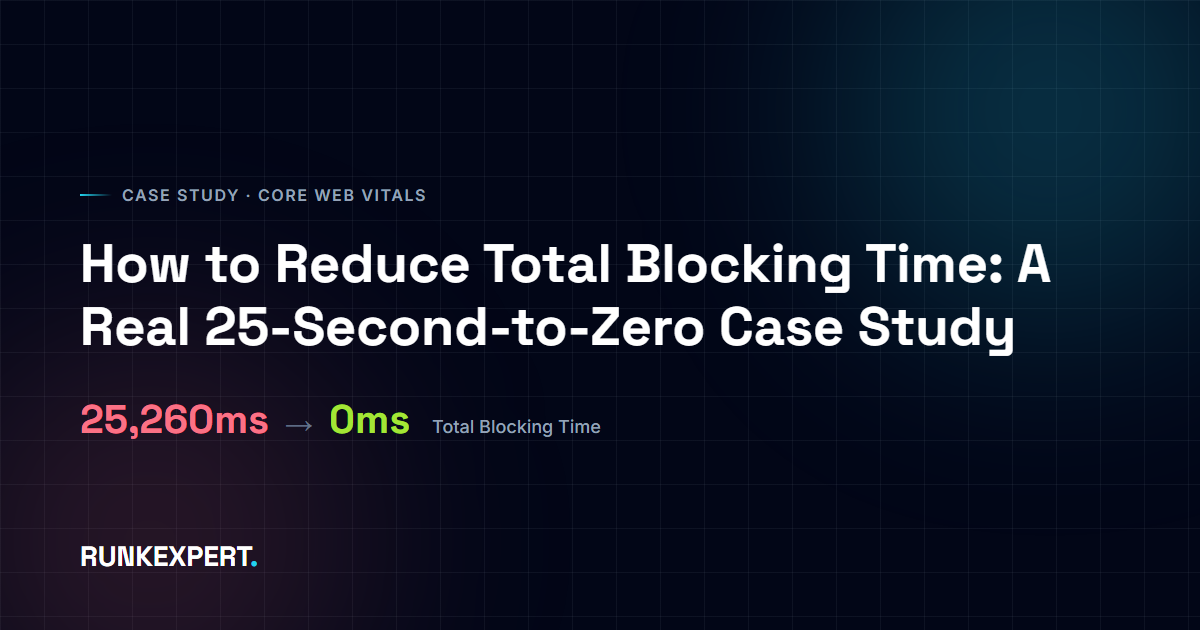
How to Reduce Total Blocking Time (TBT): A Real 25-Second-to-Zero Case Study
A real audit: how we found and fixed a 25-second main-thread deadlock on a live site, taking Total Blocking Time from 25,260ms to 0ms.