How to Optimize for Google AI Overviews Without Chasing a Moving Target
Google’s AI Overviews have done something the search results page hasn’t seen in years: moved the answer above the links. For some queries, a visitor now reads an AI-generated summary — with citations — before they ever see the first blue link. Naturally, everyone wants to know how to get into that summary. The honest answer is that you can’t guarantee it, but you can materially improve your odds, and the things that do so are mostly things good technical SEO already rewards.
First, Set the Right Expectation
There is no ai-overview: true tag. Google assembles each Overview dynamically, per query, from sources it judges relevant and trustworthy — and it changes constantly. Anyone selling a guaranteed method is selling certainty that doesn’t exist.
What you’re actually optimizing for is extractability and trust: making it easy for a model to pull a clean, correct answer from your page and confident enough in your source to attribute it. That’s it. Everything below serves those two goals.
Write in Extractable Passages
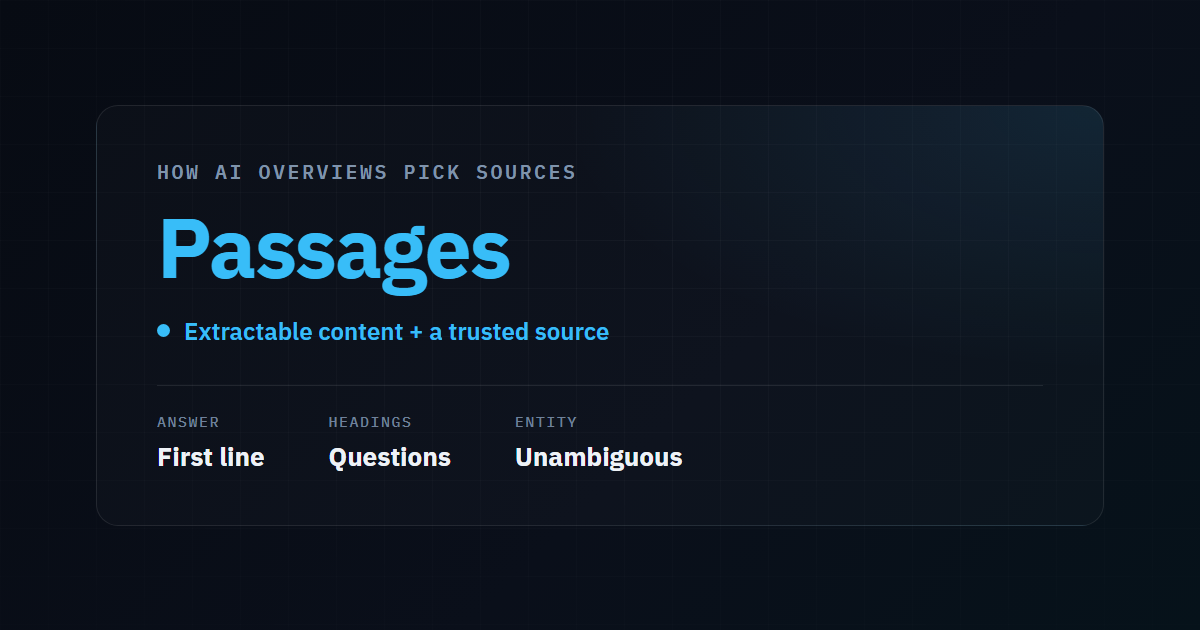
AI Overviews are built by pulling passages — specific, self-contained chunks that answer a specific question — not whole articles. Content structured as extractable passages gets pulled; content where the answer is buried in a wandering paragraph does not.
- Answer the question in the first sentence of a section, then elaborate. Lead with the conclusion; support it after. A model scanning for an answer finds it immediately.
- Use descriptive headings that mirror real questions. A section titled “How long does an SEO audit take?” is far easier to match to a query than one titled “Timelines.”
- Keep answer passages self-contained. A chunk that only makes sense after reading three paragraphs above it is hard to extract cleanly.
This is the same discipline behind a good FAQ, which is why FAQ-structured content punches above its weight in AI results.
Make Your Entities Unambiguous
Models cite sources they can confidently identify. If it’s unclear who published a page or what authority stands behind it, it’s a riskier citation. This is where structured data and entity-based SEO earn their keep:
- A clear, consistent Organization identity across your site — same name, same entity, linked by schema
@id— tells a model exactly who is making the claim. - Author and publisher signals on articles establish that a real, accountable entity stands behind the content.
- Consistent facts across your pages, structured data, and any
llms.txtmean a model isn’t reconciling contradictions to figure out what’s true.
Ambiguity is the enemy. The clearer your entity, the safer you are to cite.
Don’t Neglect the Technical Layer
An Overview can’t cite what a crawler can’t reach or read. The technical fundamentals are a prerequisite, not a bonus:
| Signal | Why it matters for AI citation |
|---|---|
| Crawlable, server-rendered content | Content that only appears after client-side JavaScript may not be read |
| Fast load / good Core Web Vitals | Reachability and quality signals correlate with trust |
| Clean HTML structure | Well-formed headings and lists are far easier to parse into passages |
| Accurate structured data | Removes ambiguity about what the page is and who published it |
If your content depends on JavaScript to appear, or your page is a slow tangle of nested divs, you’ve made extraction harder before a single word of content is judged. We cover the crawlability and rendering fundamentals in the Core Web Vitals audit checklist.
Play the Queries Where a Summary Isn’t Enough
Part of the strategy is choosing your battles. For a simple factual query, an Overview may fully answer it and the click never comes. But plenty of intent can’t be satisfied by a summary:
- Comparisons and decisions — people still click through to weigh options in depth.
- Anything requiring a tool or action — a summary can’t run your free audit or scope your project.
- Nuanced, high-stakes topics — users want the full source, not a paraphrase.
Content aimed at these queries keeps its click-through even in an AI-heavy results page, and being cited in the Overview on top of that is pure upside.
The Realistic Playbook
There’s no trick here, which is the point. You improve your AI Overview odds by doing recognizable good work: lead sections with clear answers, structure content as extractable passages, make your entity unmistakable with clean structured data, keep the technical layer crawlable and fast, and weight your content toward queries where depth still wins the click. Do that and you’re a strong candidate. Skip it and no tactic will save you.
Check the Foundation First
Extractability starts with a crawlable, fast, well-structured page. Our free tool checks whether the technical basics — rendering, Core Web Vitals, crawlability — are actually in place, which is the floor everything above stands on.
Want to Be the Cited Source?
We engineer content and its technical foundation to be extractable and attributable — clean entity signals, structured data, fast crawlable pages — so you’re a candidate to be cited, not just indexed.
Published by the Runkexpert Engineering Team. Last updated 2026-07-26.