What Is On-Page SEO? The Complete Guide to Optimizing Your Pages
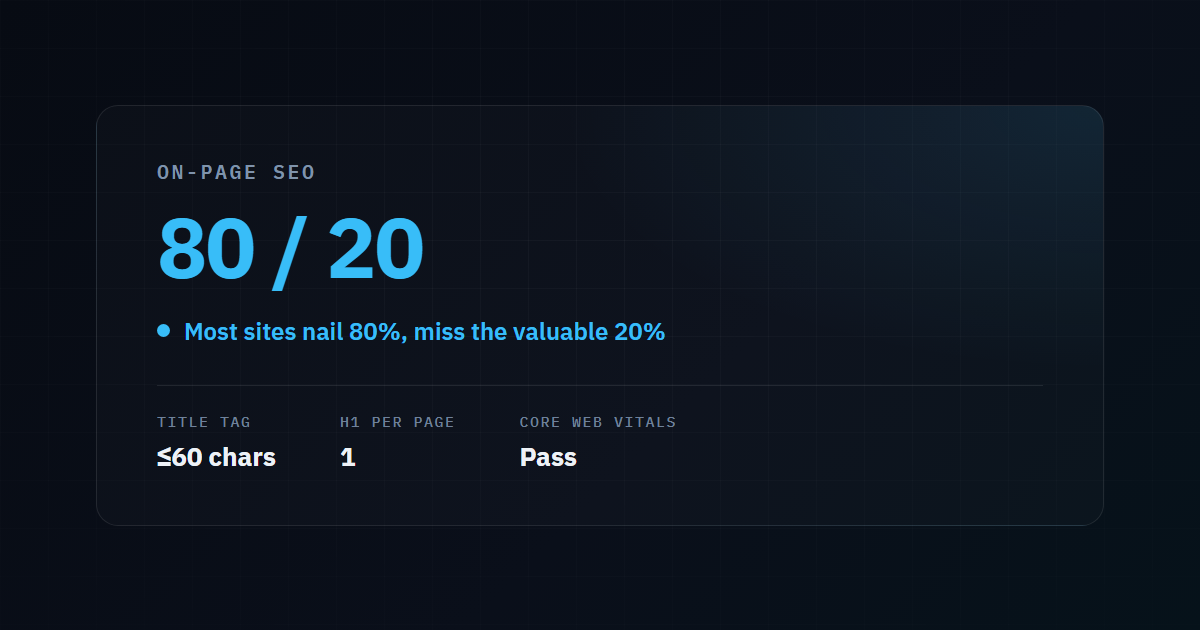
Of the three parts of SEO, on-page is the one you have the most control over — and, for exactly that reason, the best place to start. It’s also the part most sites get about 80% right and then leave the last, most valuable 20% on the table. This guide covers what on-page SEO actually is, what genuinely moves rankings in 2026, and the checklist to run against your own pages.
What On-Page SEO Means
On-page SEO is optimizing the elements on your own pages — content, HTML tags, structure, and internal links — so search engines can understand what each page is about and rank it for the right searches.
The “on-page” label is literal: every factor is something living on the page itself, which you can change directly. That’s what distinguishes it from off-page SEO (backlinks and signals from other sites) and makes it the natural first move — no waiting on anyone else, no earning trust from third parties. Just work you can do today.
The On-Page Factors That Actually Matter
Not all on-page elements carry equal weight. Here’s the honest hierarchy:
| Factor | Why it matters |
|---|---|
| Content that matches intent | The single biggest factor — the page must actually answer what the searcher wants, not just contain the keyword |
| Title tag | Tells search engines and users what the page is; unique, descriptive, ideally under ~60 characters |
| Heading structure (H1–H3) | One clear H1, logical subheadings — this is how machines (and AI) parse your page into sections |
| Internal links | Connect related pages, pass authority, and show search engines your site’s topical structure |
| Meta description | Doesn’t rank you directly, but a good one lifts click-through from the results page |
| Image optimization | Descriptive alt text and compressed files — accessibility, image search, and load speed |
| URL structure | Short, readable, descriptive URLs beat long query-string messes |
The mistake most sites make is treating this as a keyword-placement exercise — stuffing the target phrase into the title, headings, and first sentence and calling it done. Modern search is far past that. It’s evaluating whether the page comprehensively and clearly answers the intent, which is a content-quality question, not a keyword-density one.
What Changed for On-Page SEO in 2026
On-page SEO used to end at keywords and tags. It doesn’t anymore. Two shifts matter:
- Entity clarity and structure. Search engines and AI systems want to understand not just your keywords but the entities on your page — who published it, what it’s about, how it connects to known concepts. Clean structured data and consistent identity signals now do real work. (This overlaps heavily with AI SEO.)
- Machine-readable formatting. Content structured as clear, self-contained passages — a question as a heading, a direct answer beneath it — is easier for both Google and AI Overviews to extract and cite. Wandering, unstructured prose is not.
Both mean on-page SEO is now as much about clean structure as about good words.
The On-Page Factor Hiding in the Technical Layer
Here’s the part most on-page guides skip, and it’s the one we’d argue matters most: page speed is an on-page factor now. Core Web Vitals — how fast your largest element loads, how stable the layout is, how quickly the page responds to a tap — are on-page signals, and they’re decided by engineering, not copywriting.
You can nail every title tag and heading on a page and still lose rankings because it takes four seconds to become usable. That’s why we wrote a dedicated deep-dive on on-page SEO for Core Web Vitals — the on-page work that lives in the code, not the content, and that most marketers never touch.
An On-Page SEO Checklist You Can Run Today
For any important page, check:
- One clear, unique title tag under ~60 characters that describes the page accurately.
- Exactly one H1, with logical H2/H3 subheadings that mirror real questions.
- Content that fully answers the intent — not just mentions the keyword, but resolves what the searcher came for.
- Internal links to related pages, with descriptive anchor text.
- A meta description that earns the click.
- Compressed images with descriptive alt text.
- A clean, readable URL.
- Fast Core Web Vitals — the technical on-page factor.
Run that against your top pages and you’ll usually find the same last-20% gaps everywhere: a template-generated title, a missing meta description, a hero image nobody compressed, or a page that quietly fails Core Web Vitals.
See Your On-Page Health in Under a Minute
Our free tool checks the objective on-page signals directly against a live fetch of your site — title tags, headings, meta descriptions, Core Web Vitals, and crawlability — and reports each one plainly.
Want the Whole Page Optimized, Content and Code?
On-page SEO is where content and engineering meet — and where most sites are strong on one side and weak on the other. We handle the engineering half: the speed, structure, and crawlability signals that turn good content into ranking content.
Published by the Runkexpert Engineering Team. Last updated 2026-07-26.