What Is AI SEO? (IA SEO / AI for SEO, Explained Without the Hype)
“AI SEO” — or IA SEO, if you work in French — is one of the most-searched and least-clearly-defined terms in marketing right now. Part of the confusion is that it means two genuinely different things, and people use it for both without saying which. Sort that out and the whole topic gets much simpler. Here’s the honest breakdown, minus the breathless “AI changes everything” framing.
AI SEO Means Two Different Things
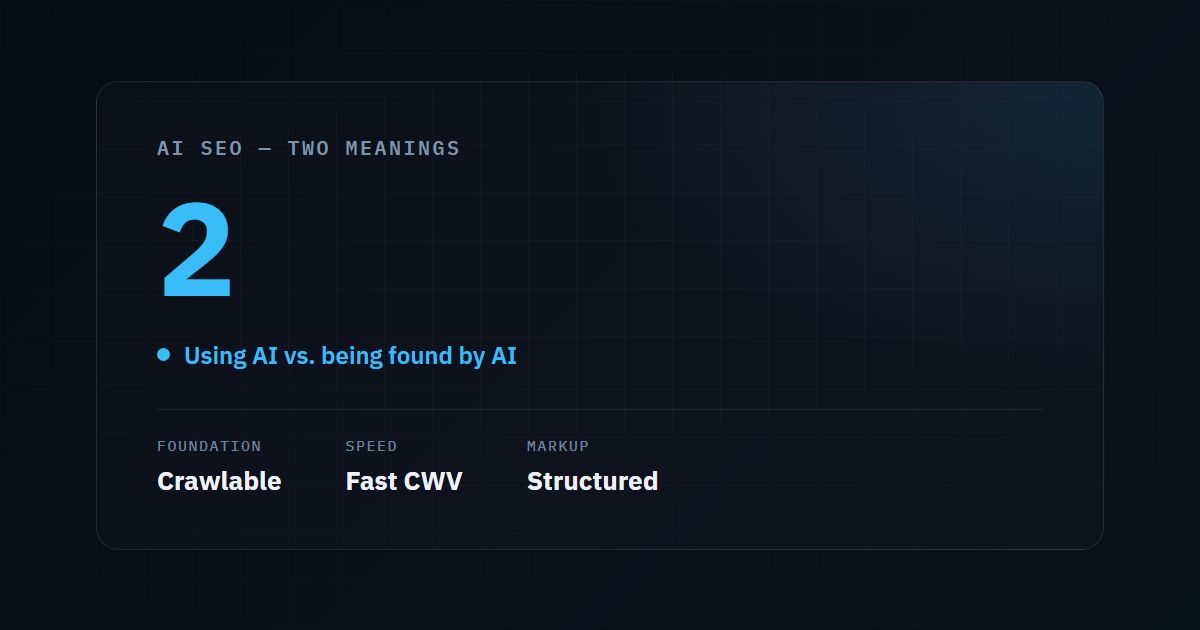
When someone says “AI SEO,” they mean one of these — and the tactics are completely different depending on which:
- Using AI to do SEO. Applying AI tools to speed up the work — keyword research, content drafting, technical audits, competitor analysis. AI as the worker.
- Optimizing to be found by AI. Making your site the source that AI-powered search experiences — Google AI Overviews, ChatGPT, Perplexity — pull from and cite. AI as the audience.
Most of the hype conflates them. But “which AI tool should I use to write content” and “how do I get cited in ChatGPT” are unrelated questions. Let’s take them separately.
Meaning 1: Using AI to Do SEO Work
This is the more familiar one. AI tools can genuinely compress work that used to take hours:
- Keyword and topic research — spotting patterns and gaps across large data sets.
- Content drafting and optimization — first drafts, outlines, and structure suggestions.
- Technical audits — scanning hundreds of pages for issues in minutes.
- Competitor analysis — summarizing what’s ranking and why.
The honest caveat: AI accelerates the work, it doesn’t replace the judgment. AI-generated content that nobody edited for accuracy or genuine insight tends to be generic — and generic content is exactly what search engines have spent years learning to filter out. The teams that win with AI tools use them to move faster on work they’d still stand behind, not to mass-produce filler.
Meaning 2: Optimizing to Be Found by AI (the Bigger Shift)
This is the one that’s actually changing the game, and it goes by a more precise name: Generative Engine Optimization, or GEO. Instead of optimizing to rank in a list of links, you’re optimizing to be the source an AI cites in its generated answer.
The tactics are recognizable but reweighted:
- Extractable content. AI answers are built from passages. Lead each section with a direct answer, use headings that mirror real questions, keep answers self-contained. We cover this in how to optimize for AI Overviews.
- Strong entity signals. AI cites sources it can confidently identify and trust. Clean structured data and consistent identity tell it who’s making the claim — the subject of getting cited by ChatGPT.
- Technical accessibility. An AI can’t cite what it can’t crawl or read. Content that only appears after JavaScript, or a page too slow to fetch, is invisible to the systems you’re trying to reach.
If you want the full framework, we wrote it up as Generative Engine Optimization (GEO).
What Both Meanings Have in Common
Here’s the thread that ties it together and cuts through the hype: neither version of AI SEO works without solid fundamentals. AI tools can’t rescue a site with broken crawlability. AI systems won’t cite a page they can’t load. Underneath both meanings sits the same unglamorous foundation:
| Fundamental | Why it still matters for AI SEO |
|---|---|
| Crawlable, server-rendered content | AI can only use what it can actually read |
| Fast Core Web Vitals | Reachability and quality signals both correlate with trust |
| Clear content matching intent | AI extracts answers from clear content, not keyword soup |
| Accurate structured data | Removes ambiguity about who and what your page is |
This is the part the hype skips: AI SEO is mostly good SEO, made legible to machines. The developer-level version of this — the code and architecture that make a site AI-ready — is its own topic, covered in AI SEO for developers.
The Honest Takeaway
AI SEO isn’t a magic new discipline that obsoletes everything before it. It’s two things wearing one name — AI as a tool that speeds up your work, and AI as an audience you optimize to be cited by — both standing on the same technical fundamentals SEO always required. Get the fundamentals right, then layer the AI-specific tactics on top. Reverse that order and no AI tactic will save you.
Check Whether Your Site Is AI-Ready
Being cited by AI starts with being crawlable, fast, and clearly structured. Our free tool checks those fundamentals against a live fetch of your site — the floor that any AI SEO strategy stands on.
Want to Be the Source AI Cites?
We engineer sites to be extractable and trustworthy for AI search — clean entity signals, structured data, and fast crawlable pages — so you’re a candidate to be cited, not just indexed.
Published by the Runkexpert Engineering Team. Last updated 2026-07-26.