What Is Kimi AI? And What It Means for AI Search and GEO
Every few months a new AI assistant enters the conversation, and lately one name that keeps coming up is Kimi. If you’ve seen it mentioned alongside ChatGPT, Claude, and Gemini and wondered what it actually is — and whether it matters for how people find your website — here’s the grounded explanation, plus what it means for search and Generative Engine Optimization (GEO).
What Kimi AI is
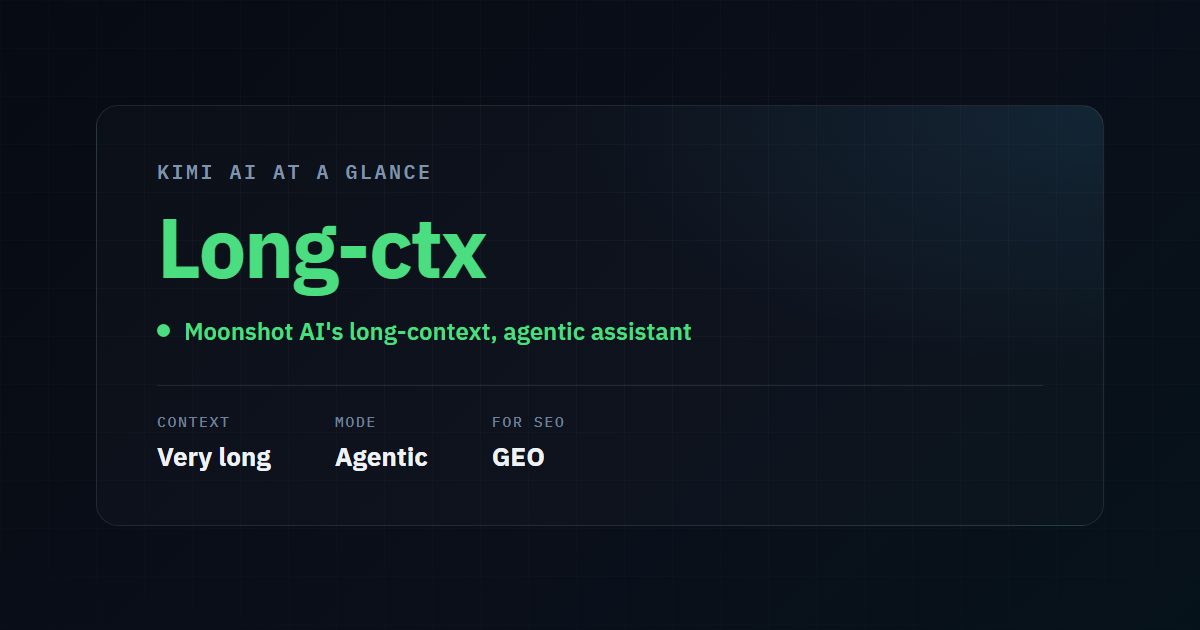
Kimi is an AI assistant built by Moonshot AI, a company based in China. It rose to prominence for two things in particular:
- Long context — the ability to read and reason over very large amounts of text at once. Where earlier assistants could only “see” a few pages of input, long-context models can ingest long documents, or many pages together, and answer questions across all of it.
- Increasingly agentic behavior — the ability to take multi-step actions toward a goal, not just respond to a single prompt. This is the same industry-wide shift toward AI that can do things, not only answer.
Like other modern assistants, Kimi can work from external information and, in its search-capable forms, draw on the web. That last capability is what pulls it into the SEO conversation at all.
A note on specifics: the AI landscape moves fast, and exact model versions, context sizes, and features change constantly. Treat any precise figure as a snapshot in time, not a permanent spec — the strategic points below don’t depend on the exact numbers.
Where Kimi fits among the assistants
It helps to place Kimi next to the names you already know. They’re more alike than different in what they mean for content visibility:
| Assistant | Made by | Notably known for |
|---|---|---|
| ChatGPT | OpenAI | Broad adoption, web search, plugins/agents |
| Claude | Anthropic | Long-context, careful reasoning, coding |
| Gemini | Tight integration with Google Search / AI Overviews | |
| Kimi | Moonshot AI | Long context, agentic use, strong China-market presence |
The takeaway isn’t the differences — it’s the sameness. Every one of these reads external content, extracts what’s useful, and prefers sources it can identify and trust. That shared behavior is what makes a single optimization strategy work across all of them.
Why long context matters for your content
Kimi’s headline strength — long context — has a direct implication for what kind of content wins. When an assistant can ingest and reason over a whole comprehensive document rather than a thin snippet, depth and structure are rewarded:
- Comprehensive, genuinely useful pages give a long-context model more to work with than a shallow 300-word post.
- Clear structure — real headings, lists, and tables — helps the model navigate and extract from a large document accurately.
- Self-contained sections remain the unit of extraction, even when the whole page is long.
In other words, long context doesn’t reward padding — it rewards substance that’s well organized. That’s the same content quality bar that E-E-A-T and good SEO have always pointed toward.
What to actually do about it
Here’s the practical part, and it’s deliberately un-exotic: you don’t optimize for Kimi specifically — you optimize for the behavior all these assistants share. The AI SEO and GEO fundamentals cover every engine at once:
| Do this | Why it works for Kimi (and every AI) |
|---|---|
| Write extractable, self-contained passages | Answers can be lifted cleanly, even from long pages |
| Make your entity unambiguous (schema, consistent naming) | The AI can trust and attribute your source |
| Keep pages crawlable, fast, server-rendered | The content is actually readable — see AI SEO for developers |
| Publish genuinely comprehensive, structured content | Long-context models reward depth done well |
One situational note: because Kimi has strong reach in the Chinese market, businesses targeting Chinese-speaking or China-adjacent audiences have a more direct reason to care about it specifically. For everyone else, it’s one more reason the GEO work you should already be doing pays off.
The honest bottom line
Kimi AI is Moonshot AI’s long-context, increasingly agentic assistant — a capable member of the same generation as ChatGPT, Claude, and Gemini. For search, it reinforces a trend rather than starting a new one: assistants that read the web reward content that’s extractable, trustworthy, technically accessible, and genuinely substantial. Optimize for that, and you’re ready for Kimi and whatever assistant comes next — without chasing any of them individually.
See if AI can read your site
Every AI engine, Kimi included, can only use content it can crawl and read. Our free tool checks whether your pages are server-rendered, fast, and crawlable — the foundation of any AI-visibility strategy.
Want to be ready for AI search?
We engineer sites to be extractable, trustworthy, and technically accessible to AI assistants — so your content is a candidate to be cited and summarized across every engine, not just indexed by traditional search.
Published by the Runkexpert Engineering Team. Last updated 2026-07-31.