AI SEO for Developers: Making Your Site Legible to AI Search at the Code Level

Most writing about AI SEO is aimed at marketers — write extractable content, build your brand, get cited. All true, and all downstream of something developers own: whether an AI system can actually read your site in the first place. This is the code-level view. If the general AI SEO overview is the “what,” this is the “how it’s actually implemented.”
The Developer’s Job in One Sentence
AI SEO for developers is making sure the machine can access, parse, and confidently attribute your content — before any content tactic can matter. An AI can’t cite a passage it never received, can’t trust a source it can’t identify, and can’t extract an answer from markup it can’t parse. Those three problems — access, parsing, attribution — are engineering problems.
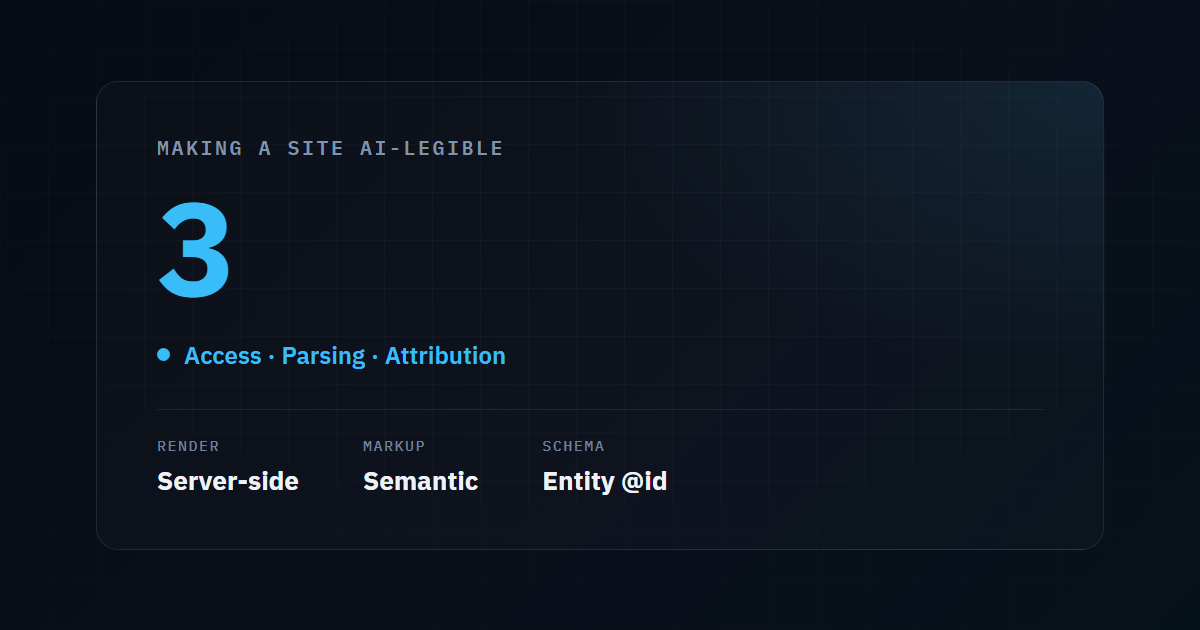
Access: Rendering Strategy Decides What AI Sees
This is the big one, and it’s invisible from the marketing side. If your content is injected by client-side JavaScript after the page loads, then what an AI crawler receives depends entirely on whether it executes that JavaScript — and many don’t, or do so incompletely.
| Rendering approach | What an AI crawler receives |
|---|---|
| Client-side rendering (SPA) | Often an empty shell — content may never be seen |
| Server-side rendering | Full content in the initial HTML |
| Static generation | Full content, pre-built, fastest to fetch |
The rule for AI SEO is simple: the content must exist in the HTML response, not be assembled in the browser. Server-side rendering or static generation guarantees that. This is the same reason a static-first architecture performs so well for AI visibility — the content is just there, in the document, for anything that fetches it.
Parsing: Semantic Markup Becomes Extractable Passages
AI answers are built from passages. Whether your content parses cleanly into passages is a markup question:
- Use real semantic elements — headings, lists, tables, sections — not a soup of nested
divs. A model reconstructing your page’s structure relies on the tags meaning what they say. - Match headings to questions. A heading of “How do I reduce INP?” is trivially matchable to a query; “Optimization” is not.
- Keep passages self-contained. A chunk that only makes sense after three paragraphs of prior context is hard to lift cleanly.
Clean HTML isn’t just an accessibility nicety here — it’s the difference between content a model can extract and content it skips because it can’t tell where the answer starts and ends.
Attribution: Structured Data That Removes Ambiguity
AI systems prefer to cite sources they can confidently identify. Structured data is how you make your identity unambiguous in machine-readable terms:
- A stable
Organizationentity with a consistent@id, referenced across every page, so there’s one canonical “you.” Article/TechArticleschema linking each piece of content to that publisher entity.FAQPageschema that explicitly maps questions to answers — directly useful to systems assembling answers.
The technique is the same one behind getting cited by ChatGPT: don’t make an AI guess who’s behind a claim. Tell it, in a format built for machines.
A Developer’s AI SEO Checklist
- Content in the HTML response — server-rendered or static, never client-only.
- Semantic markup — headings, lists, tables that mean what they say.
- Question-shaped headings with self-contained answers beneath them.
Organizationschema with a stable@id, referenced site-wide.Article/TechArticle+FAQPageschema on content pages.- Fast, crawlable pages — good Core Web Vitals, no crawl blocks.
- A clean, accurate
llms.txtas a bonus signal — see llms.txt best practices.
Why This Beats Chasing Tactics
Marketers can write the most extractable content in the world, but if it’s trapped behind client-side rendering, wrapped in meaningless markup, and published by an ambiguous entity, an AI won’t use it. The developer work isn’t a supporting act to AI SEO — it’s the precondition for it. Get access, parsing, and attribution right, and the content tactics finally have something to stand on.
Test Whether AI Can Read Your Site
Our free tool checks the fundamentals that decide AI legibility — whether content is server-rendered and crawlable, how fast the page is, and whether the technical basics are sound.
Want It Implemented Properly?
We build sites AI-ready at the code level — server-rendered content, clean semantic markup, and a full structured-data graph — so the marketing tactics on top actually reach the AI systems they’re aimed at.
Published by the Runkexpert Engineering Team. Last updated 2026-07-26.