Quebec French vs France French: The SEO Differences That Actually Matter
If you’re expanding into French-speaking Canada, there’s a tempting shortcut: you already have French content written for France, so just point it at Quebec and call it bilingual. It’s not wrong, exactly — Quebec French and France French are the same written language, and a Quebecer will understand your Paris-written copy perfectly. But for SEO, “understood” and “optimal” are different bars, and the gap between them is where rankings quietly leak. Here’s what actually differs and what to do about it.
Same Language, Different Search Behavior
The written forms of Quebec and France French are far closer than the spoken forms — a well-written French article reads fine in both markets. The SEO differences aren’t about grammar; they’re about which words people type into Google and what signals relevance to a local audience. Three things matter:
- Vocabulary differences on specific commercial and everyday terms.
- hreflang correctly distinguishing the versions — but only when they genuinely differ.
- Local relevance signals that tell Google (and users) the content is for them.
Vocabulary: Where Keywords Actually Diverge
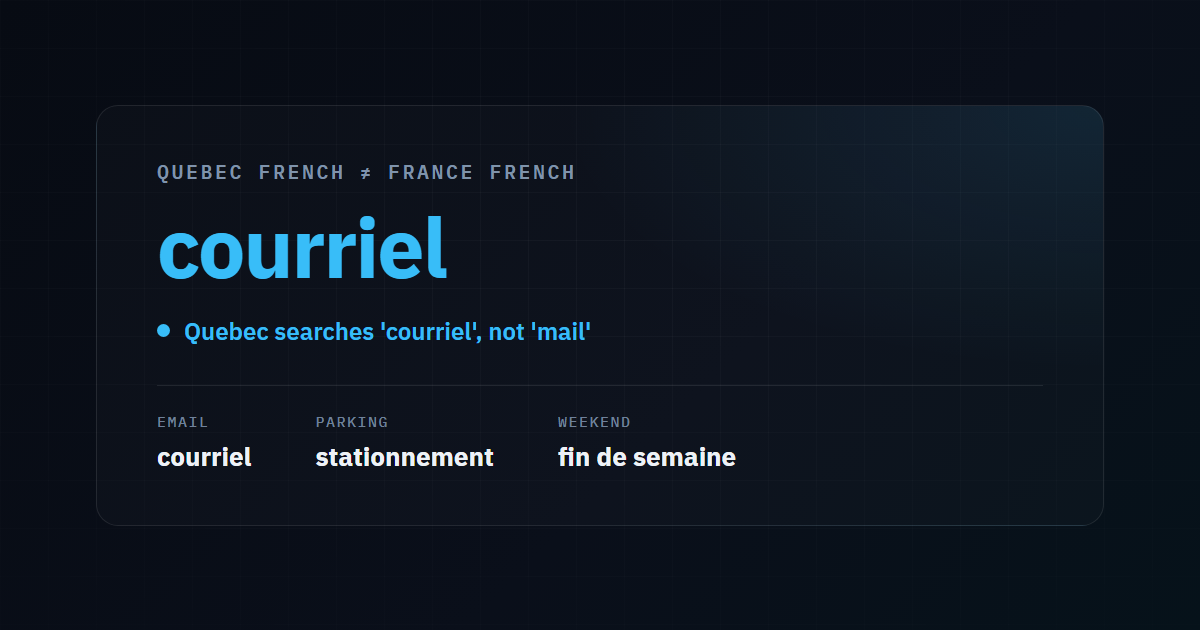
Most words are identical. The ones that aren’t tend to cluster around commerce, technology, and daily life — exactly the terms that show up in high-intent searches. A few illustrative examples:
| Concept | France French (common) | Quebec French (common) |
|---|---|---|
| e-mail / mail | courriel | |
| Shopping / to shop | shopping / faire du shopping | magasinage / magasiner |
| Weekend | week-end | fin de semaine |
| Car | voiture | char (informal), auto |
| Parking | parking | stationnement |
Quebec French also tends to prefer French-derived terms where France French has absorbed the English word — courriel over mail, stationnement over parking. If your keyword targeting uses the France-French anglicism and your Quebec audience searches the French-derived term, you’re optimizing for a word they don’t use. For informational content this rarely breaks anything; for product, service, and commercial-intent pages, it’s a real miss.
The practical step: do keyword research against the Quebec market specifically, not just France, for any commercially important term. Don’t assume the word that wins in France wins in Quebec.
hreflang: Do It Only When the Content Differs
This is where good intentions create technical SEO problems. The rule is simple and worth repeating: don’t create an fr-CA version that’s identical to your fr-FR version. Duplicate content under two hreflang tags splits your authority and gives Google two near-identical pages to choose between, for no benefit.
The correct progression:
- Start at language level. A single
frversion serves both markets fine when the content is generic. This is the right default and requires no extra work. - Localize specific pages when there’s a reason — a commercial page where vocabulary matters, or content addressing something Quebec-specific.
- Only then introduce region hreflang for that page:
fr-FRfor the France version,fr-CAfor the genuinely distinct Quebec version, withenand anx-defaultcompleting the set.
We cover the mechanics of getting reciprocal, non-duplicative hreflang right in the bilingual website performance guide — the same discipline applies whether you’re splitting by language or by region.
Local Relevance Beyond Words
Vocabulary is the obvious layer; local relevance is the quieter one. Content that references Quebec realities — provincial context, local examples, the bilingual environment Quebec businesses operate in — signals to both users and search engines that it’s genuinely for that market, not a France page with the flag swapped. You don’t need to fake a local presence you don’t have, but content written with Quebec in mind reads differently from content merely translated at it.
The Legal Backdrop (Briefly)
Quebec’s French-language legislation can require businesses operating in the province to provide French commercial content, sometimes with French given equal or greater prominence than English. The details depend on your business and confirm them with a qualified advisor — but the SEO implication is clear enough: for the Quebec market, strong French content isn’t a bonus feature. It’s frequently expected, both by the law and by users who will trust a proper French experience over an obvious afterthought.
A Sensible Approach for Most Sites
You don’t need to fork your entire site into two French variants. For most businesses expanding into Quebec:
- Keep a single quality French version as the default.
- Research Quebec vocabulary for your commercially important keywords and adjust those specifically.
- Localize and split (with proper
fr-CAhreflang) only the pages where the difference genuinely matters. - Write with Quebec context in mind rather than translating France content blindly.
That captures the upside — real relevance to Quebec searchers — without the crawl-budget waste and duplicate-content risk of a full, redundant fork.
Check Your Multilingual Setup
If you already run French content, our free tool checks the technical fundamentals — including the language and crawlability signals that underpin any multilingual setup — so you know the foundation is sound before you localize further.
Expanding Into Quebec?
We help sites target French-speaking Canada properly — Quebec keyword research, correct non-duplicative hreflang, and bilingual architecture that’s fast in both languages. It’s a niche few agencies handle well.
Published by the Runkexpert Engineering Team. Last updated 2026-07-26.