llms.txt Best Practices: What the File Is, and How to Write One That Follows the Spec
If you’ve run your site through a modern SEO tool recently, you may have seen a new category — “agent accessibility” or “AI readiness” — flagging a file most people have never heard of: llms.txt. It’s a young standard, the tooling around it is inconsistent, and a lot of the advice online gets the format subtly wrong. Here’s what it actually is, what the spec really requires, and how to write one that passes.
What llms.txt Is (and Isn’t)
llms.txt is a Markdown file at the root of your domain that hands AI models a curated map of your site: a one-line description of what you do, and a set of links to your most important pages, each with a short explanation. The idea is that instead of an AI crawling and guessing at your whole site, it can read one clean file that tells it what matters.
Two honest caveats up front:
- It’s a proposed standard, not an official one. Adoption is real but uneven, and no search engine is obligated to use it.
- Google’s search crawler ignores it. It will not change your traditional rankings. If a tool implies otherwise, it’s overselling.
So why bother? Because it’s cheap, it’s a reasonable bet on where AI-assisted discovery is heading, and — if you’re already publishing content you want cited by AI tools — it’s part of the same hygiene as clean structured data and Generative Engine Optimization.
The Format the Spec Actually Requires
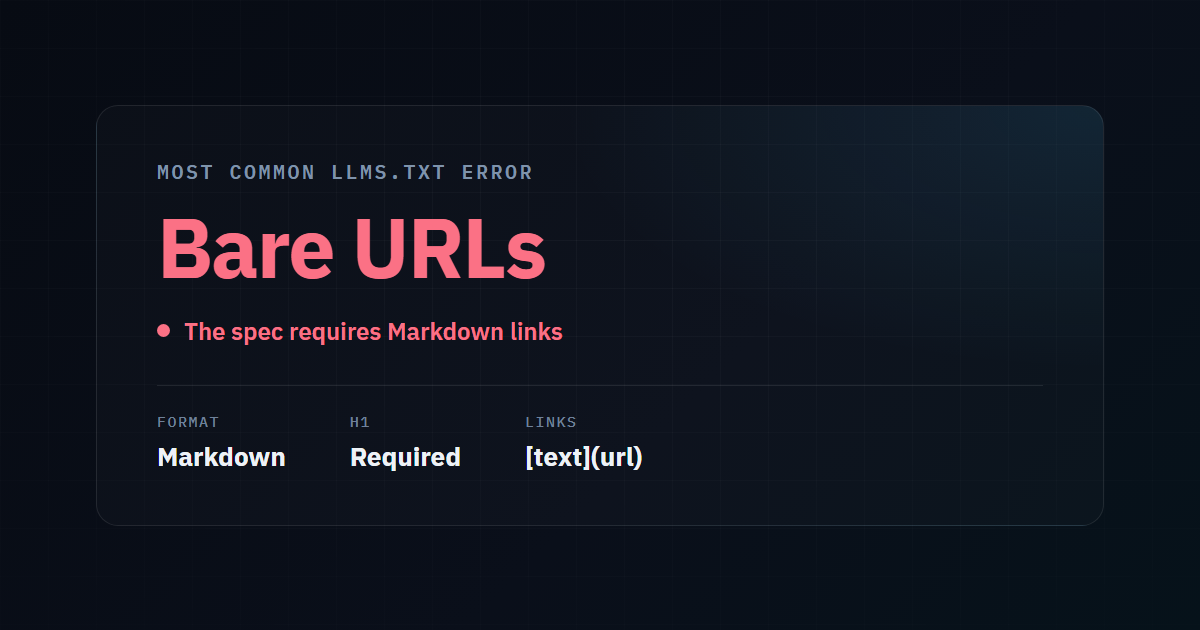
This is where most llms.txt files fail an audit. The spec is specific, and the single most common mistake is using bare URLs instead of Markdown links. The required structure:
- An H1 with your site or project name. This is the only strictly required element.
- A blockquote (
>) with a short summary of what the site is. - Optional detail paragraphs — plain prose, no headings, giving context.
##sections, each containing a list of links — and every link must be a Markdown link with an optional description:- [Title](url): description.- An optional
## Optionalsection for secondary links an AI can skip if it’s short on context.
Here’s a minimal, spec-correct example:
# Example Co

> Technical consultancy specializing in web performance.

We help businesses diagnose and fix slow websites, with a focus
on Core Web Vitals and modern web architecture.

## Core Pages

- [Services](https://example.com/services/): What we offer and how engagements work.
- [Free audit tool](https://example.com/audit/): Instant technical check of any URL.

## Articles

- [How to fix INP](https://example.com/blog/inp/): Diagnosing interaction delay.

## Optional

- [About](https://example.com/about/): Company background.
The Mistakes That Trip Audits
From reviewing real files, the recurring failures are:
| Mistake | Fix |
|---|---|
Bare URLs (- https://...) | Wrap every link as [Title](url): description |
| No H1 or no blockquote summary | Add both — the H1 is mandatory, the summary near-mandatory |
| Headings used as content, not link groups | ## sections should hold link lists, not paragraphs |
| Stale links to moved or deleted pages | Audit it like a sitemap — dead links undermine trust |
| Outdated facts (old pricing, old services) | The file is a summary of you; keep it accurate |
That last one matters more than it looks. An llms.txt that lists pricing or services you no longer offer doesn’t just look sloppy — it feeds wrong information to any AI that reads it.
Keep It in Sync With Your Site
The failure mode of any hand-maintained file is drift. Your llms.txt was accurate the day you wrote it and wrong three product updates later. Two habits prevent this:
- Treat it as part of your deploy, not a one-off. When services, pricing, or key pages change, the file changes in the same commit.
- Re-audit it periodically the same way you’d re-check a sitemap — every link should still resolve, and every fact should still be true.
A Realistic Expectation
Adding a correct llms.txt won’t move your Google rankings, and anyone promising that is confused about what the file does. What it does is make your site marginally more legible to the growing set of AI tools that read it, at almost zero cost. That’s the right framing: cheap, forward-looking hygiene — not a growth hack.
If you care about AI citation specifically — being the source an assistant quotes — the higher-leverage work is in your content and structured data, which we cover in getting cited by ChatGPT.
Check Your Site’s Technical Foundations
llms.txt sits alongside the rest of your technical SEO — sitemaps, structured data, crawlability. Our free tool checks the fundamentals that actually move rankings, so you know the load-bearing pieces are solid before optimizing the experimental ones.
Want the Whole Stack Done Right?
We handle the full technical foundation — structured data, crawlability, performance, and AI-readiness files included — as part of engineering sites that rank and get cited.
Published by the Runkexpert Engineering Team. Last updated 2026-07-26.