
SEO vs. GEO: The Ultimate Guide to Search in the Age of AI
For over two decades, the rules of the internet were simple: you optimized for Google, you climbed the Blue Links, and you harvested the traffic. But in 2026, the “Search Engine” is being replaced by the “Generative Engine.”
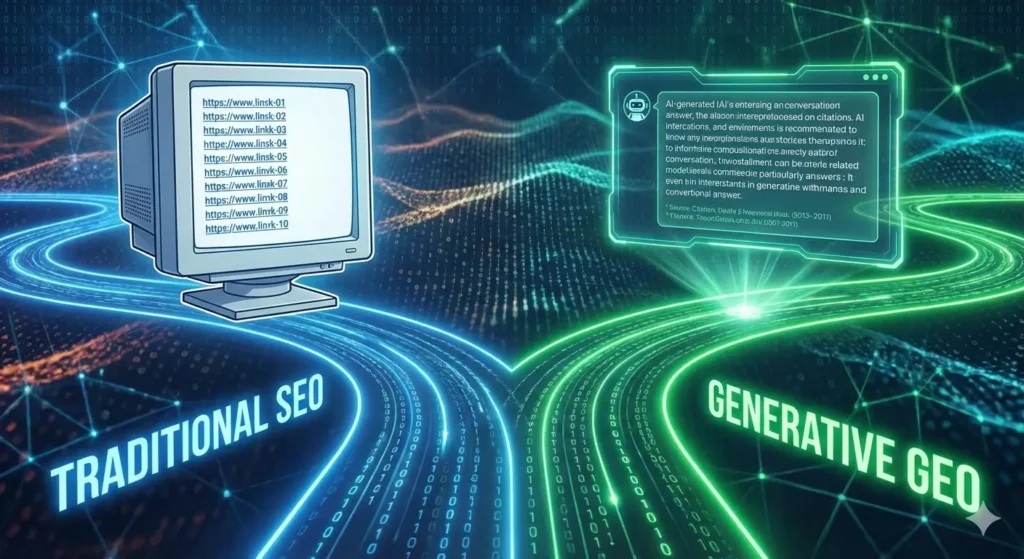
As a freelancer or digital professional, understanding the tension between SEO and GEO is no longer optional—it is the difference between being a visible authority or becoming digital ghosts. While SEO focuses on getting a user to click a link, GEO focuses on becoming the trusted answer provided by an AI.
I. The Fundamental Shift: What is GEO?
To understand the difference, we must first define the new player.
SEO (Search Engine Optimization) is the practice of orienting your website to rank higher on a Search Engine Results Page (SERP). It is based on keywords, site speed, and backlinks.
GEO (Generative Engine Optimization) is the process of optimizing content so that Large Language Models (LLMs)—like ChatGPT, Claude, Gemini, and Perplexity—cite your brand or website as a primary source in their generated responses.
Why GEO Matters Now
In 2026, users no longer want a list of ten links to explore; they want a synthesized answer. When a user asks, “What are the best freelance platforms in France for developers?”, an AI doesn’t just show a list; it writes a paragraph. If your site isn’t part of that paragraph, you don’t exist in that user’s journey.
II. SEO vs. GEO: A Side-by-Side Comparison
While they share some DNA, the strategies for winning in SEO and GEO are distinct.
| Feature | Traditional SEO | Generative Engine Optimization (GEO) |
|---|---|---|
| Primary Goal | Ranking #1–3 on Google SERP | Being the “Featured Source” in an AI response |
| Success Metric | Click-Through Rate (CTR) & Organic Traffic | Brand Mentions, Citations, Conversational Share |
| Content Structure | Keywords, H1/H2 tags, Long-form blogs | Direct answers, Fact-dense clusters, Structured Data |
| Authority Proof | Backlinks (Quantity & Quality) | Semantic relevance, Expert citations, Unique data |
| User Intent | Information gathering (Browsing) | Direct problem-solving (Synthesizing) |
III. The Pillars of Traditional SEO in 2026
SEO isn’t dead; it has become the “Technical Foundation.” You cannot have good GEO without a site that search engines can crawl effectively.
1. Technical Health
Google still cares about Core Web Vitals. If your site takes 5 seconds to load, an AI crawler might skip your data in favor of a faster source.
Mobile-First: 90% of search is now mobile or voice-driven.
HTTPS & Security: Non-negotiable for trust.
2. The Power of "Human" Backlinks
In an era of AI-generated spam, Google prioritizes links from actual humans. A link from a reputable French news outlet or a high-authority niche blog is worth more than 1,000 generic directory links.
3. Keyword Clusters
Instead of targeting “Freelance Web Dev,” modern SEO targets clusters like “How to hire a freelance web developer in Paris,” “Freelance dev web rates 2026,” and “Legal contracts for French freelancers.”
IV. The Pillars of GEO: How to Optimize for AI
GEO requires a different mental model. AI models don’t just “look” for keywords; they “understand” concepts.
1. The "Citation" Strategy
AI models are programmed to avoid “hallucinations” by grounding their answers in facts. To win at GEO, your content must be fact-dense.
Statistical Authority: Include unique data, surveys, or case studies. AI loves numbers because they are easy to cite.
Expert Quotes: Including quotes from real experts (with their credentials) makes your content more “authoritative” for an LLM to pick up.
2. Structured Data (JSON-LD)
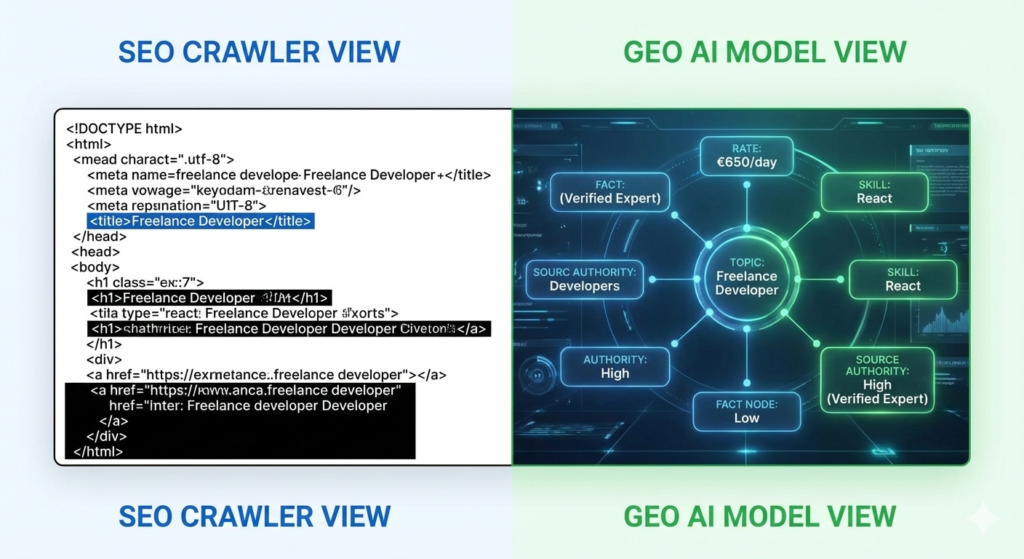
This is the “API” for AI. By using advanced Schema Markup, you tell the AI exactly what your content is. If you are a freelancer, use Person and Service schema. If you write articles, use AnalysisNewsArticle schema.
3. Conversational Content (NLP)
GEO optimization relies heavily on Natural Language Processing. Your content should mirror how people speak to an assistant.
Instead of: “Best SEO strategies 2026”
Use: “If you want to rank in 2026, the best strategy is combining SEO with generative citations…”
V. Technical Requirements for SEO vs. GEO
The backend of your website must serve two masters: the Google Bot and the AI Crawler (like GPTBot or OAI-Search).
| Technical Element | Importance for SEO | Importance for GEO | Implementation Tip |
|---|---|---|---|
| Sitemap.xml | High | Medium | Ensure all new content is indexed within minutes |
| Robots.txt | Critical | Critical | Don’t block AI crawlers if you want to be cited! |
| Schema Markup | Medium | High | Use schema.org vocabulary for every data point |
| Semantic HTML | High | High | Use <article>, <section>, and <aside> correctly |
| API Endpoints | Low | High | Allow AI models to pull real-time data if applicable |
VI. Content Strategy: Quality vs. Authority
In 2026, “Good Content” is no longer enough. AI can generate “good” content in seconds. To stand out, your content must be Uniquely Human.
The "E-E-A-T" Evolution in GEO
While we aren’t focusing on the acronym itself, the concept of Trust is vital.
Experience: Share personal anecdotes. An AI can’t say, “When I worked with a client in Marseille, we faced this specific tax issue…”
Transparency: Clearly list authors, dates, and sources
VII. SEO and GEO for Freelancers: Business Strategy
1. For the Freelance Developer
You aren’t just building a website; you are building an AI-Ready Infrastructure. You ensure that the site’s code is so clean and structured that any AI can ingest its data.
Upsell: “GEO-Ready Architecture Audit.”
2. For the Freelance Content Writer
You aren’t just writing blogs; you are writing Knowledge Bases. You create content that serves as the “source of truth” for a specific niche.
Upsell: “AI Optimization & Citation Strategy.”
3. For the SEO Consultant
Your role is now a Search & Generative Strategist. You track not just where the site ranks on Google, but how often it appears in ChatGPT or Perplexity answers.
VIII. Measuring Success in a GEO World
The old metrics (Rankings, Clicks) are fading. The new metrics are “Share of Model.”
Brand Mention Frequency: How many times does an AI mention your brand per 1,000 queries in your niche?
Citation Quality: Are you being cited as a “top expert” or just an “also mentioned”?
Sentiment Analysis: When AI talks about you, is the tone positive?
| Old Metric (SEO) | New Metric (GEO) | Tool to Measure |
|---|---|---|
| Keyword Ranking | Citation Share | Perplexity / Custom AI Agents |
| Page Views | Brand Sentiment | LLM Benchmarking |
| Bounce Rate | Interaction Depth | Conversational Analytics |
IX. Potential Pitfalls: The Risks of Ignoring GEO
If you stay stuck in the 2020 SEO mindset, you face several risks:
Zero-Click Searches: Google’s AI Overviews (SGE) solve the user’s problem on the search page. If you aren’t the source for that overview, your traffic will drop by 40-60%.
AI Exclusion: If your site has a “low trust” score, AI models may actively filter your content out of their training data to prevent hallucinations.
Irrelevance: As more users move to voice assistants (Siri, Alexa, Gemini Live), traditional text-based SEO becomes less effective.
X. Conclusion: The Hybrid Path Forward
In 2026, the winner isn’t the person who chooses SEO over GEO. The winner is the professional who masters the Hybrid Approach.
You build a website that is fast, accessible, and keyword-optimized (SEO). At the same time, you populate that site with unique data, expert opinions, and perfectly structured code (GEO). You become the authority that Google wants to rank and that AI wants to quote.