
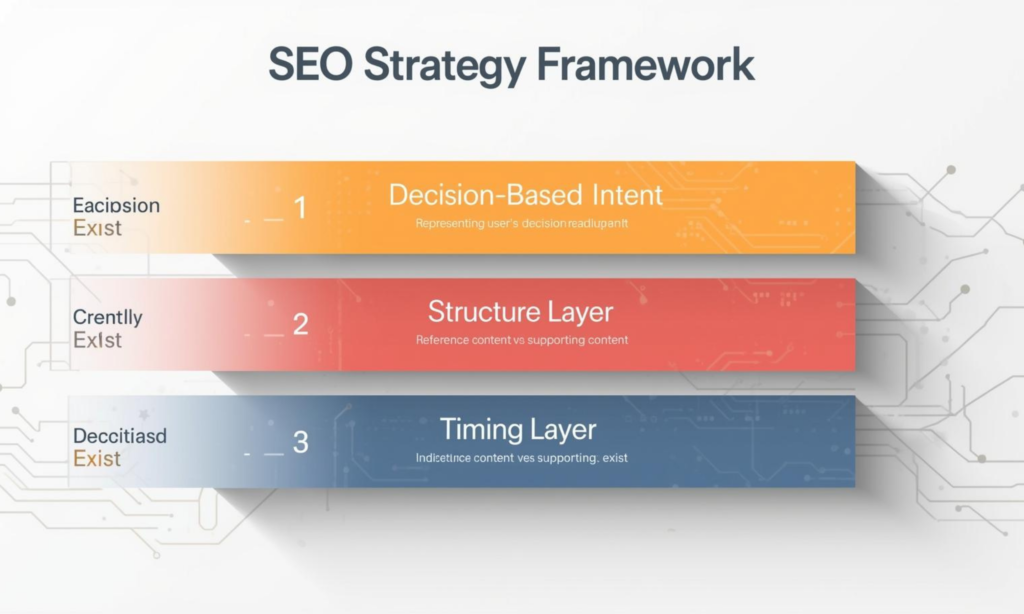
SEO outcomes are determined by decisions made before execution, not by the quality of optimization applied afterward. Pages do not fail because they are poorly written or insufficiently optimized; they fail because they were produced inside a system that never defined what should exist, why it should exist, and how it should function together. SEO success is therefore a function of strategic control, not surface-level effort.
In this context, a SEO strategy framework does not mean a checklist, a tool stack, or a publishing schedule. It means a set of constraints and sequencing rules that govern how search demand is interpreted, how intent is resolved, and how authority is constructed over time. A framework answers questions before content exists: which decisions matter, which topics deserve depth, and which pages must exist as reference content rather than disposable assets.
This distinction matters because AI-driven search systems evaluate structure, not activity. They do not reward volume, velocity, or enthusiasm. They assess whether a site demonstrates consistent decision-based intent, coherent internal hierarchy, and stable reference signals across related concepts. Without a framework that enforces those conditions, optimization becomes noise—well-executed, but directionless.
This article codifies how search strategy is actually built before keywords, content, or calendars—and why execution without this layer remains structurally capped.
What an SEO Strategy Framework Actually Is
An SEO strategy framework is not a collection of actions. It is a decision system that determines what actions are allowed to exist in the first place. Where tactics answer how to execute, a framework governs what deserves execution and in what order. This distinction is foundational to any durable search strategy.
At a structural level, a framework defines:
Which decisions the site is designed to resolve
Which topics warrant reference content versus supporting coverage
How intent maturity progresses across the site over time
This is why a search strategy can exist without a single published page, while content production without strategy quickly becomes reactive. A framework constrains choices; tactics merely fill space within those constraints.
The difference between a framework and a tactic is durability. Tactics decay because they are dependent on external conditions—algorithm updates, competitive behavior, or tool-driven signals. Frameworks remain stable because they are built on decision logic and system behavior, not on transient ranking factors. An SEO strategy framework survives changes in SERPs, formats, and AI interfaces precisely because it governs structure, not execution.
In practical terms, this is why sites with fewer pages but clearer strategic constraints often outperform larger sites operating without a framework. The advantage is not efficiency; it is control.
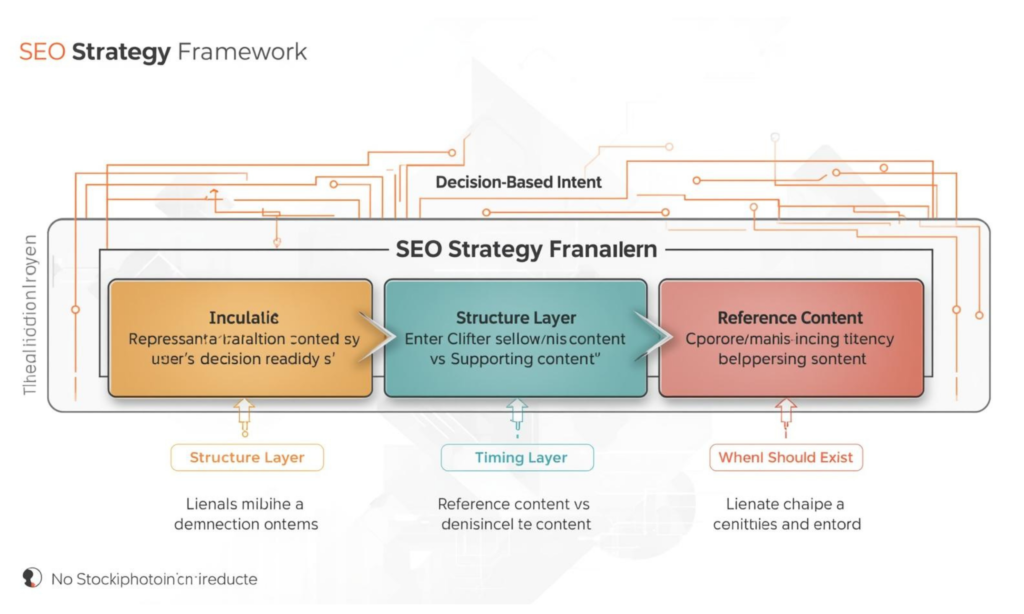
The Three Strategic Layers of SEO
This is the core conceptual model.
Explain, at a high level:
- Intent layer (decision-based intent)
- Structure layer (reference vs supporting content)
- Timing layer (when content should exist, not just what)
No steps. No how-to.
Why Keywords Are Inputs, Not Foundations
Keywords describe signals of demand; they do not define strategy. In a functional search strategy, keyword research serves a discovery role—it reveals how users articulate problems and questions. What it does not do is determine what the site should become or how information should be structured. Treating keywords as foundations reverses this relationship and destabilizes the entire system.
This is why keyword prioritization exists as a separate decision layer. Discovery expands options; prioritization constrains them. Without constraint, frameworks collapse into lists, and lists inevitably become content calendars. This failure mode is precisely what the Article Keyword Prioritization and the Article Why Keyword Research Fails diagnose: accurate data informing no strategic decisions.
At a system level, AI-driven search systems do not evaluate sites by the completeness of their keyword coverage. They evaluate whether a site resolves recurring decision contexts consistently. When keywords define structure, intent becomes fragmented across pages, reference content never stabilizes, and interpretation remains ambiguous.
In short, keywords inform strategy, but they cannot govern it. Strategy emerges only after keywords are subordinated to intent, structure, and timing decisions.
How AI-Driven Search Systems Evaluate Strategy
AI-driven search systems do not evaluate effort, frequency, or surface optimization. They evaluate coherence. At a structural level, these systems infer authority by observing how consistently a site resolves the same decision contexts across time, queries, and formats.
Several patterns matter more than individual page performance:
Structure signals intent maturity. When content is organized around decision-based intent, AI-driven search systems can infer what the site is for. Pages stop competing with each other and start reinforcing a shared interpretation.
Consolidation enables citation. Reference content earns citations because it functions as a stable anchor. It reduces ambiguity by centralizing explanation, definitions, and judgment. AI systems prefer citing one authoritative source over synthesizing across fragmented keyword pages.
Fragmentation creates decay. Keyword-driven pages that exist in isolation may rank temporarily, but they decay as intent shifts or new pages dilute relevance. Over time, AI-driven search systems deprioritize these pages because they do not contribute to a durable explanatory structure.
From an information retrieval perspective, strategy is visible only when content behaves like a system. Isolated optimization is invisible. Consistent intent resolution is not.
When Execution Exists but Strategy Does Not
Consider a site that appears, on the surface, to be doing everything correctly. It publishes regularly, earns links naturally, and maintains a baseline level of rankings across a wide range of queries. From an execution standpoint, nothing is obviously broken.
The instability emerges elsewhere. Publishing decisions are reactive—driven by trending topics, tool outputs, or perceived gaps—rather than by a unifying strategic spine. Content accumulates, but it does not converge. Each algorithm shift forces a reset because no enduring structure exists for AI-driven search systems to interpret.
The absence of an SEO strategy framework means intent is never consolidated, reference content never stabilizes, and decision-based intent is resolved inconsistently. Execution cannot compensate for this. More content increases surface area, not control. More links amplify pages, not meaning.
Without a framework, visibility remains temporary by design.
What Building the Framework Prevents
An SEO strategy framework does not exist to accelerate growth. Its primary function is to eliminate predictable failure modes before they materialize. In that sense, it operates as a risk-control layer, not a performance lever.
When a framework is present, several systemic problems are prevented by design:
Content bloat is avoided because publishing is constrained by intent coverage, not by calendar pressure. Content exists to resolve decisions, not to fill gaps.
Intent cannibalization is reduced because each page has a defined role within a decision-based intent sequence. Pages reinforce one another instead of competing for interpretation.
Strategy drift is contained because decisions remain anchored to a stable search strategy, even as algorithms, formats, or opportunities change.
Tool dependency weakens because tools return to their proper role as inputs, not decision-makers. The SEO strategy framework determines relevance; tools merely surface options.
From the perspective of AI-driven search systems, prevention is visibility. Stable structures are easier to interpret, easier to cite, and harder to displace than reactive execution.
Why Most SEO Education Never Teaches This
At a system level, SEO education does not fail because it is inaccurate; it fails because it is structurally incentivized to avoid strategy.
Several forces push education away from frameworks and toward execution:
Tactics are easier to sell because they produce visible activity. Checklists, “best practices,” and optimizations can be demonstrated without requiring a shared decision model.
Tools are easier to demonstrate because they externalize authority. Dashboards, scores, and metrics give the impression of control without forcing strategic accountability.
Strategy is harder to validate publicly because it operates upstream of results. A search strategy cannot be screenshot, graphed, or packaged as a universal recipe.
As a result, most education teaches what to do before it teaches why decisions exist. This leaves practitioners executing efficiently inside frameworks they never designed.
Runkmaster operates outside this incentive structure. It is non-vendor, non-agency, and non-volume-driven by design. Its role is not to promote tools or outputs, but to make the governing logic of search strategy explicit—especially as AI-driven search systems increasingly reward structure over activity.
Is an SEO strategy framework the same as an SEO plan?
Can small sites use a framework without teams?
Does AI search change how frameworks are built?
Where do tools fit in a framework?
Can a framework work across niches?
SEO success is not the result of executing more content or optimizing pages faster—it is the outcome of deliberate decisions made before a single keyword is chosen or article is drafted. A properly constructed SEO strategy framework organizes three critical layers: decision-based intent, reference versus supporting content, and timing of publication. This framework ensures AI-driven search systems interpret your site as authoritative and coherent, rewarding structured content rather than fragmented, reactive pages.
Without this strategic spine, even high-quality content, links, and consistent publishing can fail to produce lasting visibility. Execution alone cannot prevent content bloat, intent cannibalization, or strategy drift. By prioritizing strategy first, every subsequent choice—from keyword selection to content creation—aligns with a stable system designed for citation, relevance, and decision-driven authority.
The takeaway is clear: SEO is governed by strategy, not tactics, and frameworks create the structure that allows every piece of content to work in concert rather than at cross purposes.