
search intent framework is not about what users read; it is about what decision they are preparing to make.
Most explanations of search intent stop at labels: informational, navigational, transactional. That model was useful when search engines primarily matched pages to keywords. It is no longer sufficient in 2026. AI-driven search systems do not evaluate content based on format or surface signals; they evaluate whether a piece of content resolves the underlying decision a user is moving toward.
At a system level, intent is interpreted as decision-based intent. AI systems analyze queries, surrounding context, prior behavior patterns, and content structure to infer why a search is happening at that moment. Two users can type the same query while being in very different decision states, and modern search systems are designed to detect and accommodate that difference.
This is why search intent cannot be treated as a content-type choice or a keyword modifier exercise. It is a search strategy dependency. When intent is misunderstood, content may still rank briefly, but it will fail to earn trust, citations, or long-term visibility. When intent is understood as decision readiness, content aligns naturally with how AI-driven search systems retrieve, evaluate, and reuse information.
What Search Intent Framework Actually Means (Beyond Labels)
Search intent framework refers to the decision context behind a query, not the words used, the page format, or the assumed content type. It describes the state of judgment, comparison, or commitment a user is in when they initiate a search. In modern search strategy, intent is the signal that explains why a query exists at that specific moment, not merely what information is being requested.
Search intent is not a classification system. It is not synonymous with informational, navigational, or transactional tags, and it is not determined by keyword modifiers alone. Those labels describe surface behavior; they do not capture decision readiness. Treating intent as a label often leads to content that technically matches a query but fails to resolve the underlying decision AI-driven search systems are attempting to satisfy.
Historically, intent models emerged when search engines relied heavily on keyword matching and page-type inference. Categorizing queries helped systems approximate relevance at scale. In 2026, that approximation is no longer necessary. AI-driven search systems infer intent directly by analyzing decision signals, contextual dependencies, and content outcomes. As a result, search intent has shifted from a descriptive concept into a foundational input for search strategy itself.
Why Traditional Intent Models Break in AI-Driven Search
At a system level, traditional intent models break because they simplify intent into static labels that no longer reflect how modern search systems evaluate usefulness. Categories like informational, commercial, or transactional assume that relevance can be inferred from page type. AI-driven search systems do not operate on that assumption.
From an information retrieval perspective, format is no longer a reliable signal. Two pages can share the same structure and still serve completely different decision contexts. What matters now is whether the content reduces uncertainty at the exact moment a user is preparing to decide.
Where the Old Model Fails
Traditional intent frameworks were built for ranking documents, not for synthesizing answers. This creates several structural mismatches:
Page type ≠ decision readiness
A blog post can support a purchase decision, and a product page can still be purely exploratory.Keywords ≠ intent clarity
The same query can represent research, comparison, hesitation, or commitment depending on context signals AI can see.Length ≠ usefulness
Long content that expands options can delay a decision, while shorter content that explains trade-offs can accelerate it.
How AI-Driven Systems Interpret Intent Now
Generative systems infer user readiness, not intent labels. They evaluate multiple signals at once:
Query phrasing and modifiers
Adjacent and follow-up searches
Historical behavior patterns
The type of explanation needed to resolve ambiguity
Instead of asking “What kind of page is this?”, the system effectively asks:
“What explanation, clarification, or judgment would move this user forward right now?”
Content that answers this question aligns naturally with AI-driven search systems. Content that only matches a category does not.
Why Ambiguity Resolution Matters More Than Format
AI-driven search systems are designed to collapse uncertainty, not present options endlessly. They prioritize content that:
Clarifies trade-offs
Explains constraints
Frames consequences
Helps users choose, not just learn
This is why pages built strictly around outdated intent labels often rank inconsistently or disappear from generative answers. They describe topics, but they do not resolve decisions.
Old Model vs AI-Driven Reality
When intent is treated as a label, content competes on structure.
When intent is treated as a decision signal, content competes on clarity and judgment.
Traditional Intent Model | AI-Driven Search Reality |
|---|---|
| Classifies queries | Interprets decision context |
| Relies on page type | Evaluates explanation value |
| Matches keywords | Resolves ambiguity |
| Optimizes format | Optimizes readiness |
This distinction is why traditional intent models no longer hold in AI-driven search systems — and why decision-based intent has become a dependency, not an enhancement, in modern search strategy.

The Decision-Based Search Intent Framework
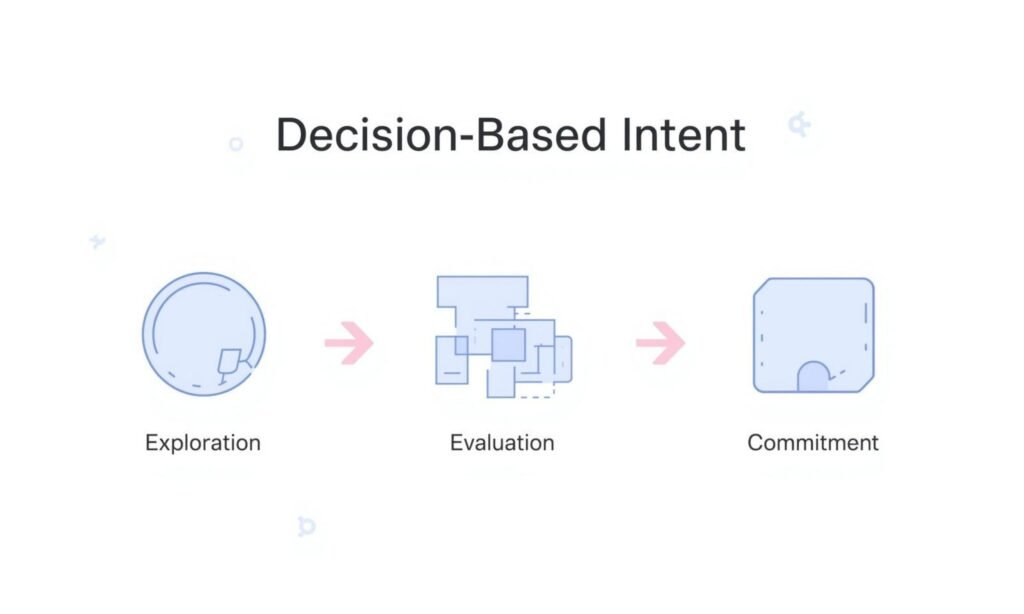
The decision-based search intent framework defines intent as a progression of decisions, not a sequence of content types. Users do not move through search results randomly; they move through states of readiness, each defined by a different kind of uncertainty they are trying to resolve.
Search intent, in this model, reflects where the user is in their decision process, not what kind of page they expect to see.
At a system level, AI-driven search systems favor frameworks that explain this progression clearly because it allows them to match explanations to user readiness instead of relying on static labels.
The Three Decision States
The framework is built around three stable intent states. These states are not trends, and they are not tied to platforms or formats. They describe how people make decisions, which is why the framework remains valid even as search systems evolve.
1. Exploratory Intent — Understanding the Problem
In the exploratory state, the user is not choosing yet. They are trying to define the problem accurately.
What they are resolving is not what to buy or which option is best, but what is actually going on.
This intent state is characterized by:
Vague or broad queries
Uncertainty about causes, terminology, or scope
A need for clarity, framing, and explanation
From a decision perspective, the user is asking:
“What am I really dealing with, and what should I understand before moving forward?”
Content that performs well here does not push solutions. It reduces confusion, establishes shared language, and narrows the problem space. AI-driven search systems surface content that explains, not content that persuades.
2. Evaluative Intent — Comparing Options
In the evaluative state, the problem is understood, but the path forward is not. The user is now deciding between possible approaches, tools, or strategies.
What they are trying to resolve is trade-offs.
This intent state typically includes:
Comparison-oriented queries
Requests for pros, cons, or differences
Signals of narrowing focus rather than expansion
From a decision perspective, the question becomes:
“Given what I now understand, which option makes the most sense for my situation?”
At this stage, AI-driven search systems prioritize content that explains why choices differ, not just what exists. Content that names constraints, limitations, and contextual fit performs better than content that lists features.
3. Commitment Intent — Preparing for Action
In the commitment state, the user has largely made a decision. What remains is confirmation and risk reduction.
They are not asking if they should act, but how safely and confidently they can do so.
This intent state is marked by:
Specific, high-precision queries
Questions about implementation, cost, or outcomes
A focus on consequences and next steps
From a decision perspective, the underlying question is:
“Am I making the right choice, and what do I need to proceed?”
AI-driven search systems surface content here that resolves doubt, clarifies expectations, and removes friction. Authority, precision, and clarity matter more than breadth.
Why This Framework Holds Over Time
This search intent framework does not depend on keyword trends, platforms, or SERP layouts. It maps to human decision behavior, which is why it remains stable even as AI-driven search systems change how information is retrieved and presented.
| Intent State | Decision Focus | What the User Is Resolving |
|---|---|---|
| Exploratory | Understanding | What the problem really is |
| Evaluative | Comparison | Which option fits best |
| Commitment | Action | How to proceed with confidence |
Search strategy becomes more predictable when intent is understood as decision progression rather than content categorization. This is why decision-based intent functions as a structural foundation, not a tactical layer, in modern search systems.
Visualizing Decision-Based Intent
To clarify decision-based search intent without overcomplicating it, we use one controlled metaphor; because it maps cleanly to decision-based intent without adding noise.
A map represents awareness of what is possible.
A route represents commitment to a specific decision path.
How This Connects to Decision-Based Intent
When a user is operating with exploratory intent, they are looking at the map.
Their decision posture is open. They are not choosing yet; they are trying to understand the landscape, constraints, and available directions.
With evaluative intent, the user begins moving from map to route.
They are no longer asking “what exists?” but “which direction makes the most sense for me?” The decision is still unresolved, but it is narrowing.
At commitment intent, the user is on the route.
The decision has effectively been made. What remains is execution, confirmation, or optimization of the chosen path.
Why This Metaphor Matters
Search intent is not about clicking pages; it is about where the user is positioned in their decision process.
Map-based queries require clarity and structure.
Route-based queries require precision and guidance.
This metaphor reinforces the core idea:
search intent reflects decision readiness, not content format or keyword type.
When Rankings Stall: Aligning Content with Decision Intent
Imagine a mid-sized educational website that ranks on page one for several high-volume keywords. Traffic looks healthy, but engagement and conversions are minimal. At first glance, everything seems “good SEO”—titles optimized, keywords included, backlinks in place.
The issue lies in misalignment with decision-based intent. Most of the content addresses exploratory questions, yet the visitors arriving are in commitment mode, ready to act but finding only general explanations. The site is giving them a map when they need a route.
Correcting the framing requires matching content to intent state:
Exploratory pages stay exploratory but funnel readers toward evaluative or commitment content.
Evaluative content highlights trade-offs, comparisons, and actionable insights.
Commitment-focused pages guide users through the final decision process, reducing friction and doubt.
Conceptually, the outcome is clear: when content matches the user’s decision posture, AI-driven search systems recognize relevance more accurately. Rankings stabilize not just because of optimization mechanics, but because the content resolves user ambiguity at each decision stage.
This demonstrates a key point: authority in AI search emerges from aligning content with decision-based intent, not from chasing keywords alone.
Why Most Content Gets Search Intent Wrong
Even experienced content teams frequently misinterpret search intent. Three common misconceptions stand out:
Intent = Keyword Modifier – Many assume that words like “buy,” “compare,” or “best” automatically define intent. In reality, modifiers signal possibilities, not decision readiness.
Intent = Funnel Stage Graphic – Marketing funnels provide structure, but they simplify human decisions. AI-driven search systems assess actual judgment and ambiguity resolution, not which box a user falls into.
Intent = Content Type – Some think a blog post, product page, or video automatically satisfies intent. Format alone does not indicate whether a user’s decision needs are met.
These misconceptions persist because:
Tools often categorize queries superficially, reinforcing assumptions.
Templates encourage checkbox thinking rather than deep analysis.
Outdated SEO education emphasizes keywords and funnels over real decision contexts.
By highlighting these common mistakes, we see that search strategy is not about labels, formats, or templates—it’s about understanding the decisions users are truly preparing to make. Content that aligns with real decision context earns authority with both readers and AI-driven search systems.
What This Means for AI-Driven Search Systems
At a system level, AI-driven search systems do not simply reward pages that rank—they aggregate answers from multiple sources to resolve decision-based intent. When content clearly addresses the user’s decision context, it is more likely to be cited or referenced by generative search engines.
Reference content, which explains concepts, resolves ambiguity, and maps decisions, consistently outperforms purely ranking content in AI citation probability. Unlike traditional SEO pages focused on traffic metrics, reference content provides a durable signal: it demonstrates that the site understands the decision users are trying to make.
In practice:
AI evaluates content not just for keyword matching, but for how effectively it helps users navigate their decisions.
Clear articulation of intent and context increases the likelihood that a page becomes a trusted source.
Clusters of reference content reinforce authority, creating a self-sustaining network of high-citation pages.
The takeaway: aligning content with decision-based intent is no longer optional. It is the factor that determines whether AI systems quote, reference, and prioritize your content over competitors.
How This Framework Informs Keyword Prioritization
Understanding decision-based intent directly shapes how you prioritize keywords within your content strategy. Not all keywords are created equal—some align with exploratory intent and should be addressed later, while others match evaluative or commitment stages and demand depth-first content to maximize impact.
By assessing intent maturity, you can determine which topics are ready to generate traffic, conversions, or monetization value, and which require preparatory content to guide users toward decision readiness. This ensures that your efforts are strategic, not scattered.
Implementing this approach reinforces keyword prioritization and strengthens your overarching search strategy, turning a long list of potential topics into a focused roadmap that both AI-driven search systems and human readers recognize as authoritative.
Common Intent-Related Mistakes
Even seasoned teams often misstep when aligning content with decision-based intent. The most frequent strategic errors include:
Publishing too early-stage content for monetization – Some pages target commitment-ready queries before the user has built awareness or understanding, leading to poor conversions despite traffic.
Forcing CTAs into exploratory intent – Adding calls-to-action to pages where users are simply learning or exploring breaks the natural decision flow and reduces engagement.
Treating all informational queries equally – Not all informational searches carry the same decision potential. Failing to differentiate intent stages results in wasted effort and diluted authority signals.
These are not tactical mistakes—they are strategic misalignments. Correcting them ensures that content matches the decision posture of users, increasing the probability that AI-driven search systems will recognize and reference your work appropriately.
FAQs
How does AI understand search intent?
Is search intent the same as funnel stages?
Can one keyword have multiple intents?
Does intent matter more than volume?
Reference-Grade Summary
Search intent reflects decision readiness, not curiosity.
AI-driven search systems reward clarity of intent resolution.
Keyword prioritization depends on intent maturity.
Reference content succeeds by aligning with decision context.
Pingback: Keyword Research Fails: SEO Breaks Without Prioritization
Pingback: Search Strategy vs Content Strategy | Runkmaster